 Add to Chrome
 Add to Firefox
 Add to Edge
OpenVO: Open-World Visual Odometry with Temporal Dynamics Awareness
Feb 22, 2026
We introduce OpenVO, a novel framework for Open-world Visual Odometry (VO) with temporal awareness under limited input conditions. OpenVO effectively estimates real-world-scale ego-motion from monocular dashcam footage with varying observation rates and uncalibrated cameras, enabling robust trajectory dataset construction from rare driving events recorded in dashcam. Existing VO methods are trained on fixed observation frequency (e.g., 10Hz or 12Hz), completely overlooking temporal dynamics information. Many prior methods also require calibrated cameras with known intrinsic parameters. Consequently, their performance degrades when (1) deployed under unseen observation frequencies or (2) applied to uncalibrated cameras. These significantly limit their generalizability to many downstream tasks, such as extracting trajectories from dashcam footage. To address these challenges, OpenVO (1) explicitly encodes temporal dynamics information within a two-frame pose regression framework and (2) leverages 3D geometric priors derived from foundation models. We validate our method on three major autonomous-driving benchmarks - KITTI, nuScenes, and Argoverse 2 - achieving more than 20 performance improvement over state-of-the-art approaches. Under varying observation rate settings, our method is significantly more robust, achieving 46%-92% lower errors across all metrics. These results demonstrate the versatility of OpenVO for real-world 3D reconstruction and diverse downstream applications.

Time-Aware World Model for Adaptive Prediction and Control
Jun 10, 2025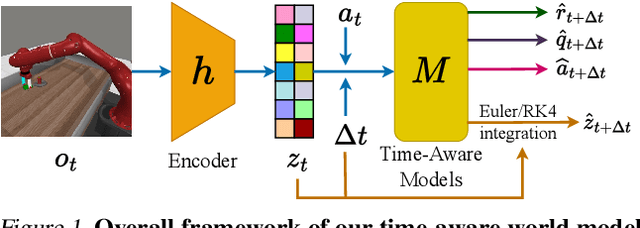
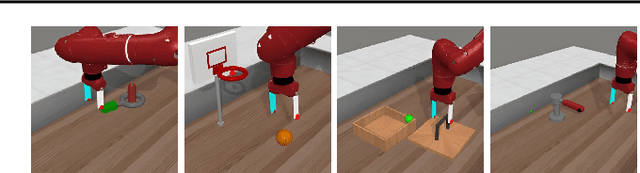
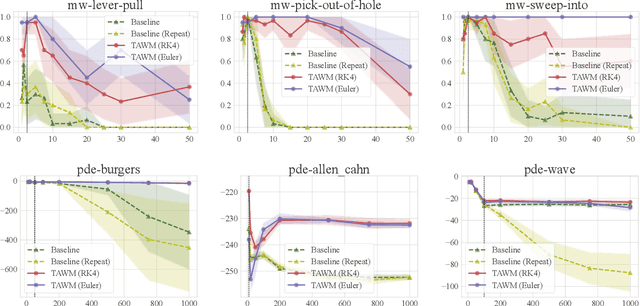
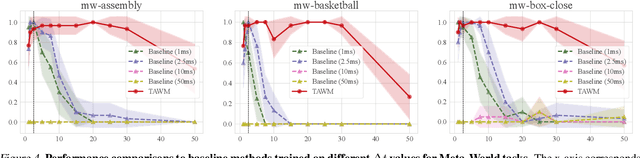
In this work, we introduce the Time-Aware World Model (TAWM), a model-based approach that explicitly incorporates temporal dynamics. By conditioning on the time-step size, {\Delta}t, and training over a diverse range of {\Delta}t values -- rather than sampling at a fixed time-step -- TAWM learns both high- and low-frequency task dynamics across diverse control problems. Grounded in the information-theoretic insight that the optimal sampling rate depends on a system's underlying dynamics, this time-aware formulation improves both performance and data efficiency. Empirical evaluations show that TAWM consistently outperforms conventional models across varying observation rates in a variety of control tasks, using the same number of training samples and iterations. Our code can be found online at: github.com/anh-nn01/Time-Aware-World-Model.
Physics-Guided Reinforcement Learning System for Realistic Vehicle Active Suspension Control
Aug 15, 2024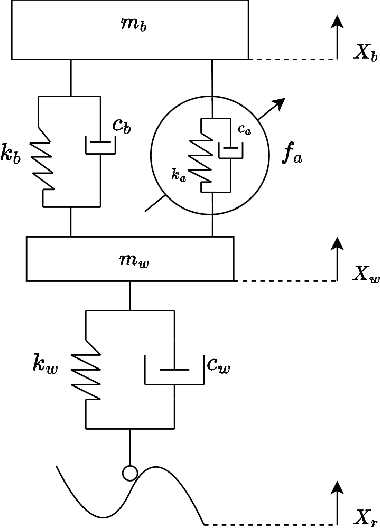
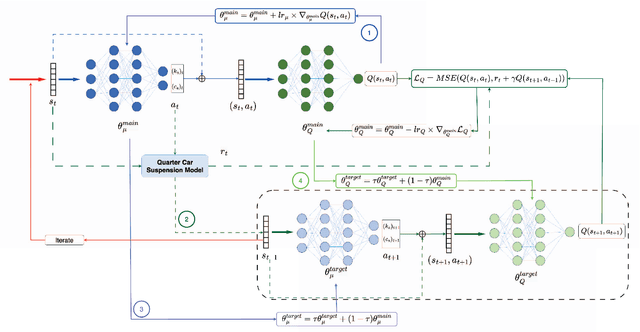
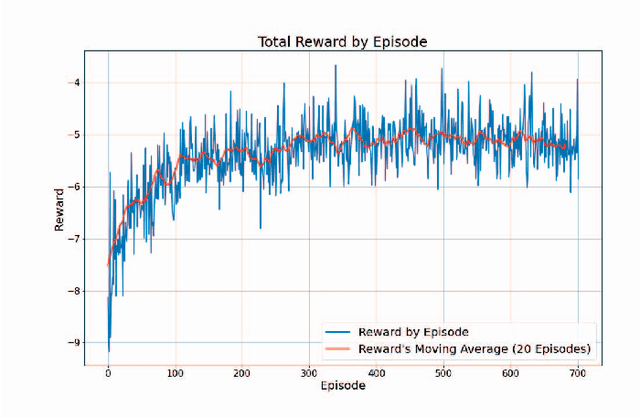
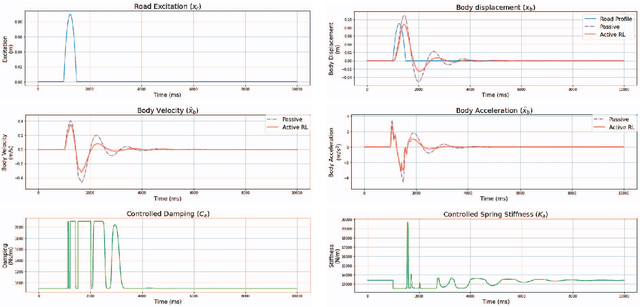
The suspension system is a crucial part of the automotive chassis, improving vehicle ride comfort and isolating passengers from rough road excitation. Unlike passive suspension, which has constant spring and damping coefficients, active suspension incorporates electronic actuators into the system to dynamically control stiffness and damping variables. However, effectively controlling the suspension system poses a challenging task that necessitates real-time adaptability to various road conditions. This paper presents the Physics-Guided Deep Reinforcement Learning (DRL) for adjusting an active suspension system's variable kinematics and compliance properties for a quarter-car model in real time. Specifically, the outputs of the model are defined as actuator stiffness and damping control, which are bound within physically realistic ranges to maintain the system's physical compliance. The proposed model was trained on stochastic road profiles according to ISO 8608 standards to optimize the actuator's control policy. According to qualitative results on simulations, the vehicle body reacts smoothly to various novel real-world road conditions, having a much lower degree of oscillation. These observations mean a higher level of passenger comfort and better vehicle stability. Quantitatively, DRL outperforms passive systems in reducing the average vehicle body velocity and acceleration by 43.58% and 17.22%, respectively, minimizing the vertical movement impacts on the passengers. The code is publicly available at github.com/anh-nn01/RL4Suspension-ICMLA23.
* \c{opyright} 2024 IEEE. Personal use of this material is permitted. Permission from IEEE must be obtained for all other uses, in any current or future media, including reprinting/republishing this material for advertising or promotional purposes, creating new collective works, for resale or redistribution to servers or lists, or reuse of any copyrighted component of this work in other works